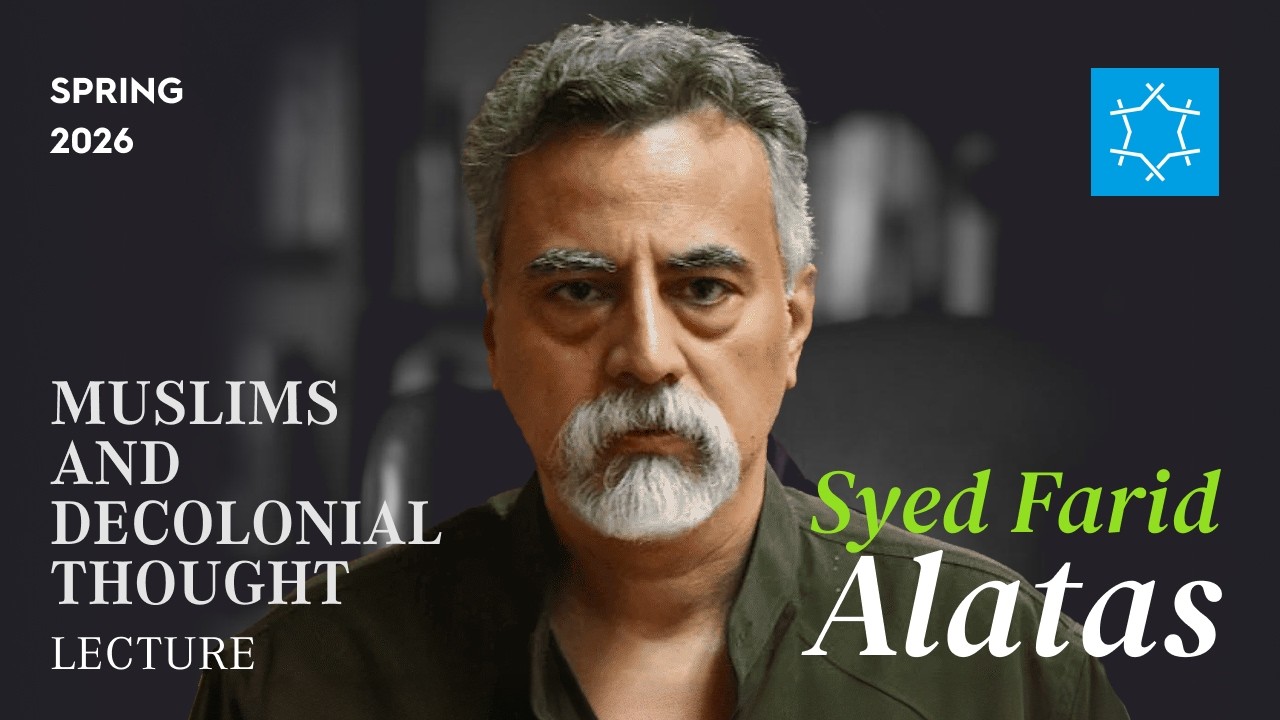
Syed Farid Alatas
Syed Farid Alatas is Professor of Sociology at the National University of Singapore and Visiting Professor at the University of Malaya. One of the most influential contemporary voices in the sociology of knowledge and the study of Islamic social thought, Professor Alatas has played a major role in expanding the boundaries of social theory beyond its conventional Eurocentric foundations.
Educated at the University of Oregon and Johns Hopkins University, where he completed his doctorate in sociology in 1991, Professor Alatas taught at the University of Malaya before joining the National University of Singapore in 1992. He later served as Head of the Department of Malay Studies at NUS from 2007 to 2013. Over the course of more than three decades, he has taught and written extensively on sociological theory, religion, development, civilizational thought, and the sociology of knowledge.
Professor Alatas is widely known for his pioneering efforts to recover non-Western intellectual traditions as sources of theoretical reflection in the social sciences. His work challenges the dominance of Eurocentric frameworks and argues for a genuinely global sociology grounded in multiple civilizational experiences. Through studies of Islamic thought, Asian intellectual traditions, and alternative sociological canons, he has helped reshape contemporary discussions concerning knowledge production and epistemic decolonization.
A major focus of his scholarship has been the thought of Ibn Khaldun, whom he regards not simply as a historical figure but as a source of living sociological insight. His books Ibn Khaldun (2013) and Applying Ibn Khaldun: The Recovery of a Lost Tradition in Sociology (2014) have been central to efforts to reintroduce Ibn Khaldun into contemporary sociological discourse and to demonstrate the continued relevance of Islamic intellectual traditions for modern social theory.
Beyond his scholarly publications, Professor Alatas has been a prominent advocate for autonomous knowledge traditions and for the construction of a genuinely global intellectual culture. His work consistently emphasizes dialogue between civilizations, the recovery of neglected intellectual resources, and the importance of developing concepts rooted in local historical and cultural experiences while remaining open to universal questions.
At Tokat, he teaches sociology, Islamic thought, and social theory as interconnected traditions of inquiry, inviting students to explore how Islamic intellectual resources can contribute to contemporary debates concerning knowledge, society, modernity, and civilization.